IT Roadmap 2026: Planning Technology in the Right Direction
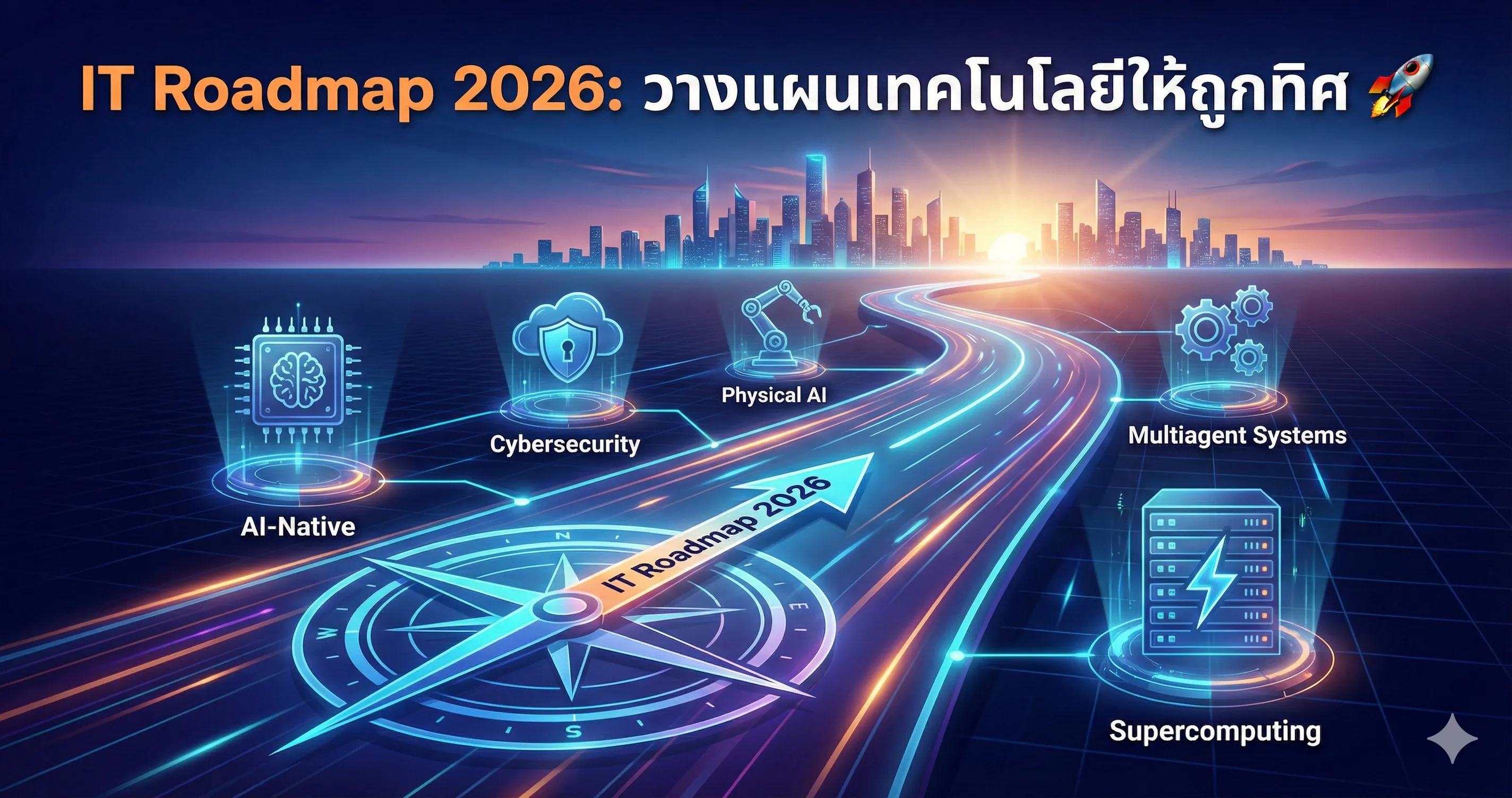
Start planning your IT Roadmap 2026 with 10 strategic technology trends from Gartner, along with guidelines for building AI Readiness, Cloud Strategy, and Security Roadmap.
IT Roadmap 2026: Planning Technology in the Right Direction 🚀
Introduction 🎯
2026 is set to be a year of major transformation in the technology world. It is no longer just about chasing the latest technologies, but about making existing technologies work effectively at the enterprise level. Having a clear IT Roadmap is therefore essential to help organizations move forward with confidence and sustainability.
Reports from Gartner and Forrester indicate that 80% of AI projects fail due to a lack of proper planning and governance. This makes the right planning approach a key driver of success.
10 Strategic Technology Trends for 2026 💡
1. AI-Native Development Platforms 🤖
Development platforms with AI embedded at their core are transforming how software is built. This is not just AI as an assistant, but AI deeply integrated into organizational thinking, decision-making, and execution. Organizations must prepare by developing a clear AI strategy aligned with business objectives.
2. Multiagent Systems and Domain-Specific Language Models 🔄
Multi-agent AI systems that collaborate with each other are becoming a major focus, alongside domain-specific language models designed for particular industries or tasks. These technologies enable organizations to leverage AI more effectively and precisely.
3. AI Supercomputing Platforms ⚡
High-performance computing platforms that combine CPUs, GPUs, AI ASICs, and neuromorphic computing to handle complex workloads. Gartner predicts that by 2028, more than 40% of leading organizations will adopt hybrid computing in their core operations, up from just 8% today.
4. Physical AI and Intelligent Robotics 🦾
AI that operates in the physical world through robots, drones, and intelligent machines capable of perception, decision-making, and autonomous action. This trend will significantly enhance efficiency and safety in manufacturing, logistics, and critical infrastructure.
5. Preemptive Cybersecurity and AI Security Platforms 🛡️
Proactive security powered by AI to detect and prevent threats before they materialize. Organizations must develop a cybersecurity roadmap focused on protecting critical data, implementing Zero Trust, and strengthening cloud environments.
6. Confidential Computing and Digital Provenance 🔐
Technologies that protect data while it is being processed, combined with digital provenance systems that ensure traceability and trust. These capabilities are increasingly critical in an era where data protection and privacy are paramount.
7. Geopatriation and Regional Cloud 🌏
The relocation of critical systems closer to home in response to regional regulations and requirements. Europe and the United States are establishing their own regulatory frameworks, leading to a more regionally distributed IT landscape.
8. Hybrid and Multi-Cloud Strategy ☁️
No organization can rely on a single cloud anymore. A hybrid architecture is required to extend cloud capabilities to locations that demand low latency and strong data control.
9. Data & AI Readiness 📊
Preparing data for AI is the foundation of success in the AI era. Reports show that 41% of data-related budgets are growing faster than inflation. Organizations need a Chief Data and Analytics Officer (CDAO) and a clear data strategy.
10. ERP Modernization with AI Integration 🔄
Modernizing ERP systems to be flexible and AI-ready is essential. Organizations must build cross-functional leadership teams and align ERP strategies with business strategies from the outset.
4 Key Strategies for CIOs in 2026 📋
1. Data & AI Readiness
Build a strong, high-quality data foundation to fully support AI adoption. Organizations must assess readiness and define a clear vision and objectives.
2. AI-Enhanced Security
Leverage AI to strengthen security, particularly against phishing and increasingly sophisticated threats. A security roadmap with continuous risk management is essential.
3. Cloud & ERP Modernization
Modernize IT infrastructure to support hybrid cloud operations and upgrade ERP systems to accommodate AI and emerging technologies. Reducing technical debt and optimizing cloud spending are critical priorities.
4. Building AI-Ready Infrastructure
Develop infrastructure that is ready for AI without competing in a race to accumulate GPUs. Efficient AI compute management and strong observability are required to control distributed platforms.
Guidelines for Effective IT Roadmap Planning 🎯
An effective IT Roadmap starts with assessing the organization’s current state, followed by defining strategic themes such as protecting critical data, strengthening identity systems and Zero Trust, developing cloud environments, and enhancing threat detection and response capabilities.
Organizations should implement initiatives in phases, starting with Stabilize (0–3 months) to address critical vulnerabilities, followed by Strengthen (3–12 months) to enhance protection and monitoring, and finally Optimize to achieve long-term sustainability.
It is crucial to link each initiative to clear business outcomes, such as how enhanced cloud security can support the launch of new digital products or expansion into regions with stricter regulations.
Recommendations for Organizations in 2026 ✨
Organizations should focus on making AI a core organizational capability, selecting only truly impactful use cases. Teams should share responsibility and embed AI into daily operations, not treat it as a pilot project.
Investment in AI governance and transparency is non-negotiable. Organizations must establish explainable and auditable AI policies so executives can understand the rationale behind AI-driven recommendations.
In addition, fostering a culture of Human + AI collaboration is critical. AI will not replace decision-makers but will enhance their capabilities—providing insights while humans apply judgment in final decisions.
Conclusion 🎉
IT Roadmap 2026 is not about chasing new technologies, but about making existing technologies work effectively at scale. Success depends on AI with strong governance, GenAI embedded in real workflows, robust security systems, and readiness for a multi-cloud and post-quantum era.
The organizations that will succeed in 2026 are those that start planning today—assessing readiness, setting clear goals, and executing systematically. Remember, technology is just a tool; true success lies in how effectively it is applied to benefit the business and its people 🚀💪
Share this article
Admin User
Content Author
Related Articles